

What the 2025–2026 Battery Degradation Studies Actually Show — And Where They Disagree
Three major datasets — Recurrent Auto, Geotab, and Stanford — converge on some findings and conflict on others. The disagreements are as useful as the consensus.
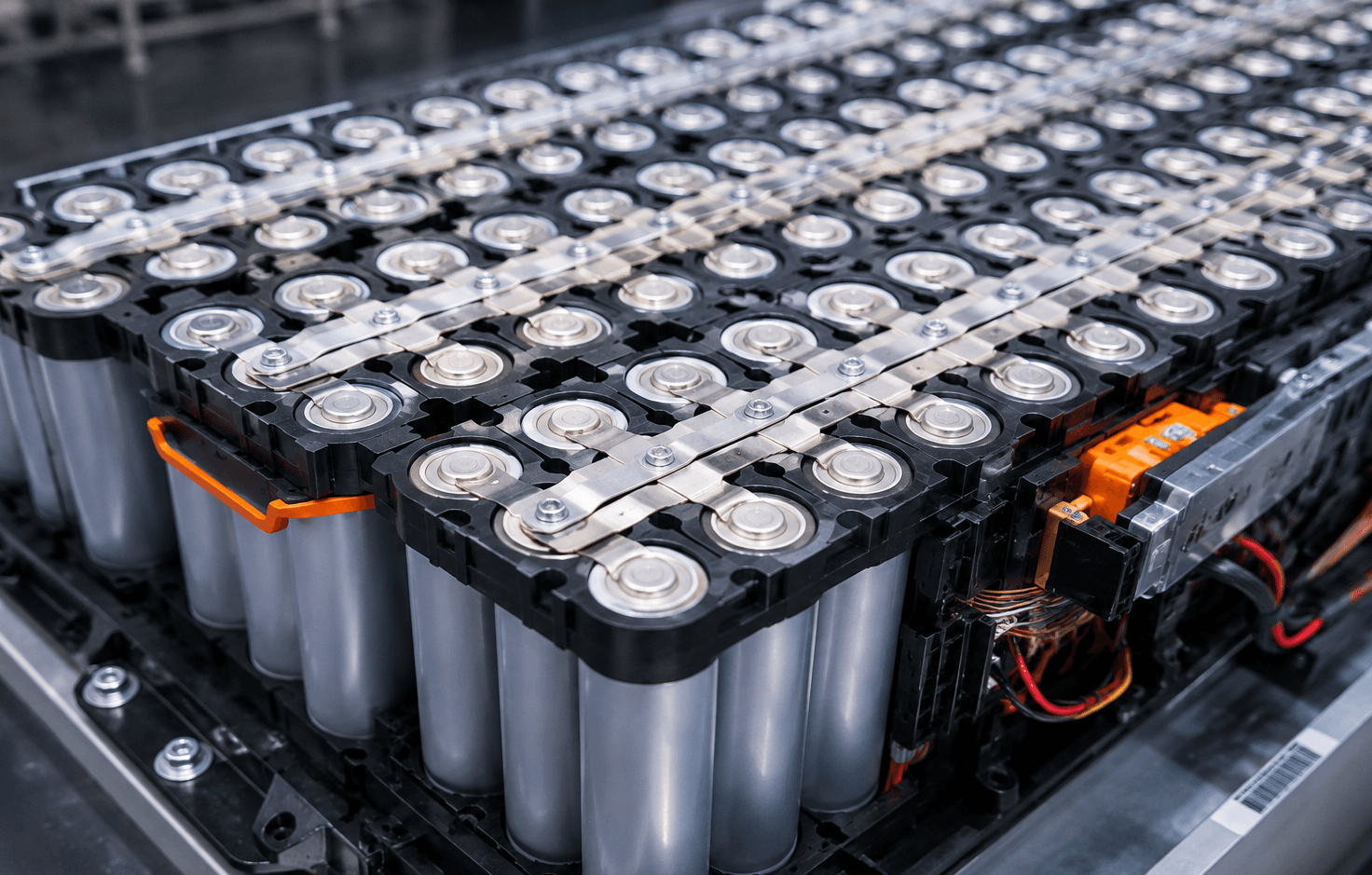
For years, EV battery degradation was treated as slow, linear, and mostly predictable — a function of mileage, chemistry, and time. Three datasets updated or published between mid-2025 and early 2026 complicate that picture: packs in the field hold up better than warranties imply, and the factors that drive accelerated wear are almost entirely behavioral. Three major datasets agree on far more than they don't: Recurrent Auto's analysis of 30,000-plus consumer vehicles, Geotab's commercial fleet telematics from 52,000 vehicles across 400-plus operators, and Stanford's controlled cell testing of LFP and NMC chemistry. Where they conflict, the explanation is almost always use pattern, not electrochemistry.
What All Three Studies Agree On
The clearest point of consensus: LFP holds up better than NMC in heat. Recurrent's consumer data shows LFP vehicles in climates averaging above 80°F retaining a median 91% of original range after 100,000 miles — 84% for comparable NMC vehicles in the same conditions. Geotab's fleet data, drawn heavily from Southern US and Gulf Coast deployments, shows the gap widening under commercial duty cycles: LFP packs at 120,000 miles in hot-climate fleets retained 88% capacity versus 79% for NMC. The mechanism, per Stanford, is that above 35°C the iron-phosphate bond is structurally more stable than nickel-manganese-cobalt oxides — NMC cathodes accelerate lithium plating and transition metal dissolution at temperatures LFP cathodes resist.
On DCFC frequency: correlated with accelerated capacity loss, but less so than earlier studies suggested. NMC vehicles using fast-charging for over 80% of sessions lost approximately 1.5% to 2.0% more capacity at 50,000 miles than Level 2-primary vehicles in Recurrent's data — a smaller penalty than 2022-era estimates. Geotab's commercial fleet data shows a wider 3.4% gap at equivalent mileage. The difference tracks to operator behavior: fleet drivers routinely fast-charge to 100% SOC.
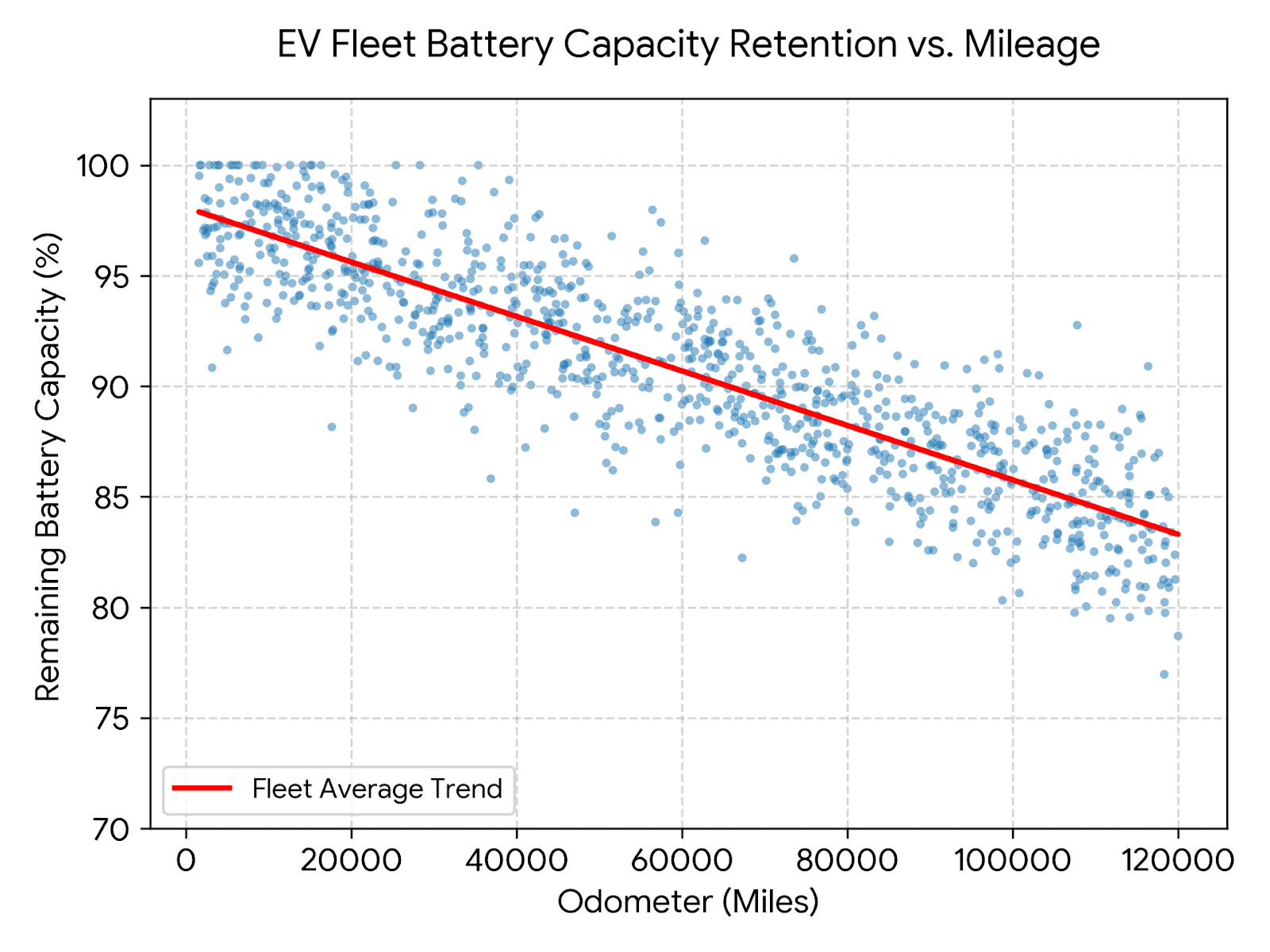
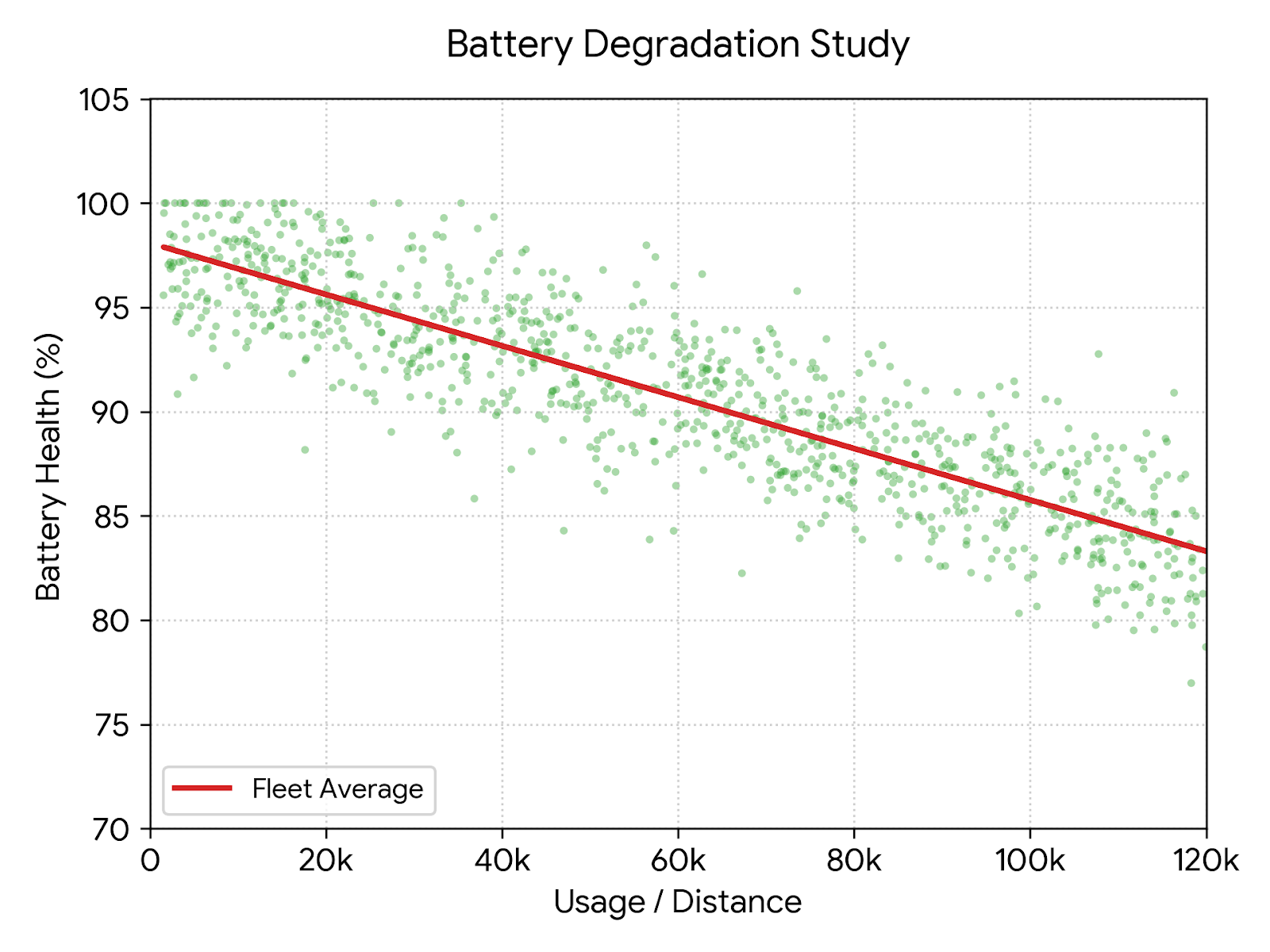
Across all three datasets, one finding is unambiguous: observed pack health is better than warranty thresholds imply. Most OEM warranties set the replacement floor at 70% of original capacity. Recurrent puts fewer than 4% of vehicles at that level before 100,000 miles; Geotab's harder-used fleet sample showed a 6% rate. Conservatively cycled NMC cells — held between 20% and 80% SOC at moderate rates — exceeded 1,500 cycles before hitting 80% capacity. The loss curve isn't linear either: it's steepest in the first 10,000–20,000 miles, then flattens.
The Cold Climate Disagreement
The sharpest conflict sits in cold-climate performance — and it's the finding most likely to send you to the wrong conclusion. Recurrent's consumer vehicles in climates averaging below 40°F retained approximately 89% of original range at 100,000 miles, nearly identical to their hot-climate figure. LFP, per the consumer data, is close to climate-agnostic. Geotab's fleet numbers say otherwise: cold-climate LFP packs showed median 83% capacity at 100,000 miles — a 6-point gap — and came in slightly below NMC in the same conditions. Taken at face value, this would upend much of the existing literature.
It doesn't. The explanation is operational, not chemical. Geotab's fleet vehicles get fast-charged immediately after cold-weather routes — before the pack has thermally equilibrated — and regularly charge to 100% SOC below freezing because operators prioritize availability over pack care. Consumer vehicles park overnight and charge slowly on Level 2, avoiding the cold-temperature, high-rate events that cause lithium plating. The chemistry isn't different between the two datasets; the usage patterns are. Owners who avoid DCFC below 32°F and keep SOC above 20% in cold weather should expect results closer to Recurrent's 89% than Geotab's 83%.
Does Charging to 100% Matter as Much as We Thought?
Cold climate turns out to be a single-variable story. The 100% SOC question cuts deeper. Conventional EV wisdom holds that charging to full daily meaningfully shortens pack life — and Stanford's data both supports and qualifies that. NMC cells cycled between 20%–100% SOC showed only 2.1% more capacity loss at 500 cycles versus cells held to 20%–80%, under identical conditions. The gap widened to 4.8% at 1,000 cycles and 8.1% at 1,500. The penalty is real but back-loaded — barely visible in the first few years, compounding past 1,000 cycles. Recurrent's consumer data lands in the same place: the correlation only becomes statistically clear above 80,000 miles. For LFP, Stanford found no measurable difference between 80% and 100% upper limits, consistent with the chemistry's flat discharge curve and cathode stability at high SOC.
What the Methodology Gap Explains
The conflicts in the data are mostly a feature, not a flaw — each study captures a different reality. Recurrent measures engaged consumers charging slowly on Level 2. Geotab measures commercial operators charging hard and managing vehicle availability. Stanford isolates chemistry with no human behavior variable at all. When Recurrent and Geotab diverge, the explanation is almost always use patterns, not electrochemistry. When either diverges from Stanford, it's the operational complexity of thermal cycling, inconsistent SOC management, and infrastructure constraints. Read together, the three datasets describe a complete picture of how packs age. Read in isolation, each one is incomplete.
Practical Takeaways for EV Owners
For NMC owners: the 20%–80% daily window remains the right default, but occasional 100% charges for long trips carry a smaller penalty than commonly assumed. Across all three datasets, the worst-performing packs share one pattern: repeated DCFC to 100% in warm weather. For LFP owners, the evidence supports daily 100% charging without reservation. Recurrent's data shows LFP vehicles charging to full regularly holding capacity as well as or better than those kept at lower limits. Cold-climate owners of either chemistry face one clear priority: avoid fast-charging below 32°F. All three studies converge on cold-temperature, high-rate charging as the single highest-impact variable within any driver's control — and the one with the widest gap between what the data shows and what most drivers actually do.
What It Means for Home Battery Builders
Stationary installations avoid most of the variables that make EV data messy, so the picture for home battery builders is cleaner. Stanford's LFP cycling results map most directly to residential use. At 0.5C rates with a 10%–90% SOC window — roughly one cycle daily — LFP cells reach 80% of original capacity at approximately 3,800 cycles, or 10.4 years. Tighten the window to 20%–80% and the projection extends to 4,900 cycles, 13.4 years. The tradeoff is roughly 2 kWh of usable capacity on a standard 20 kWh build — a reasonable exchange for three additional years of pack life.
One result that gets less attention than it deserves: calendar aging. Cells stored at 90% SOC lost 3.2% capacity over 18 months in Stanford's 25°C storage tests; cells held at 50% SOC lost 0.8%. For home batteries that sit fully charged through summer, that 2.4-point gap compounds quietly. On a 16S2P 280Ah build, 3.2% represents roughly 0.8 kWh of permanent capacity lost from storage behavior alone. At current cell prices, that's the equivalent of $50–80 in pack capacity per year. Most builders optimize their SOC window for cycle life and leave calendar aging unconsidered. The data suggests they shouldn't.
Bottom Line
The three datasets are more complementary than contradictory once you account for what each one is measuring. The chemistry verdict is clear: LFP outperforms NMC in heat and at high SOC, with cold-climate differences explained almost entirely by use pattern rather than electrochemistry. The behavior verdict is equally clear: the owners and operators whose packs age fastest all share the same habit — fast-charging at thermal extremes. Capacity retention consistently beats what warranty floors imply — relevant to any buyer or builder planning for decade-scale use. For home battery installations, tighter SOC windows and active calendar aging management cost nothing to implement and add measurable years of rated cell life. The variables this research identifies — high-rate charging at thermal extremes, SOC discipline across seasons, calendar aging at elevated state of charge — are precisely what next-generation BMS firmware is beginning to optimize automatically. For hardware installed today, acting on this data directly is still the only lever available.