

Rivian R2 Review: The $45,000 EV That Costs $57,990
Production started in April. First deliveries are arriving. The R2 has genuinely impressive specs — 335-mile EPA range, 210 kW peak charge, efficiency that beats the Model Y. It also costs $13,000 more than Rivian spent two years telling everyone it would.
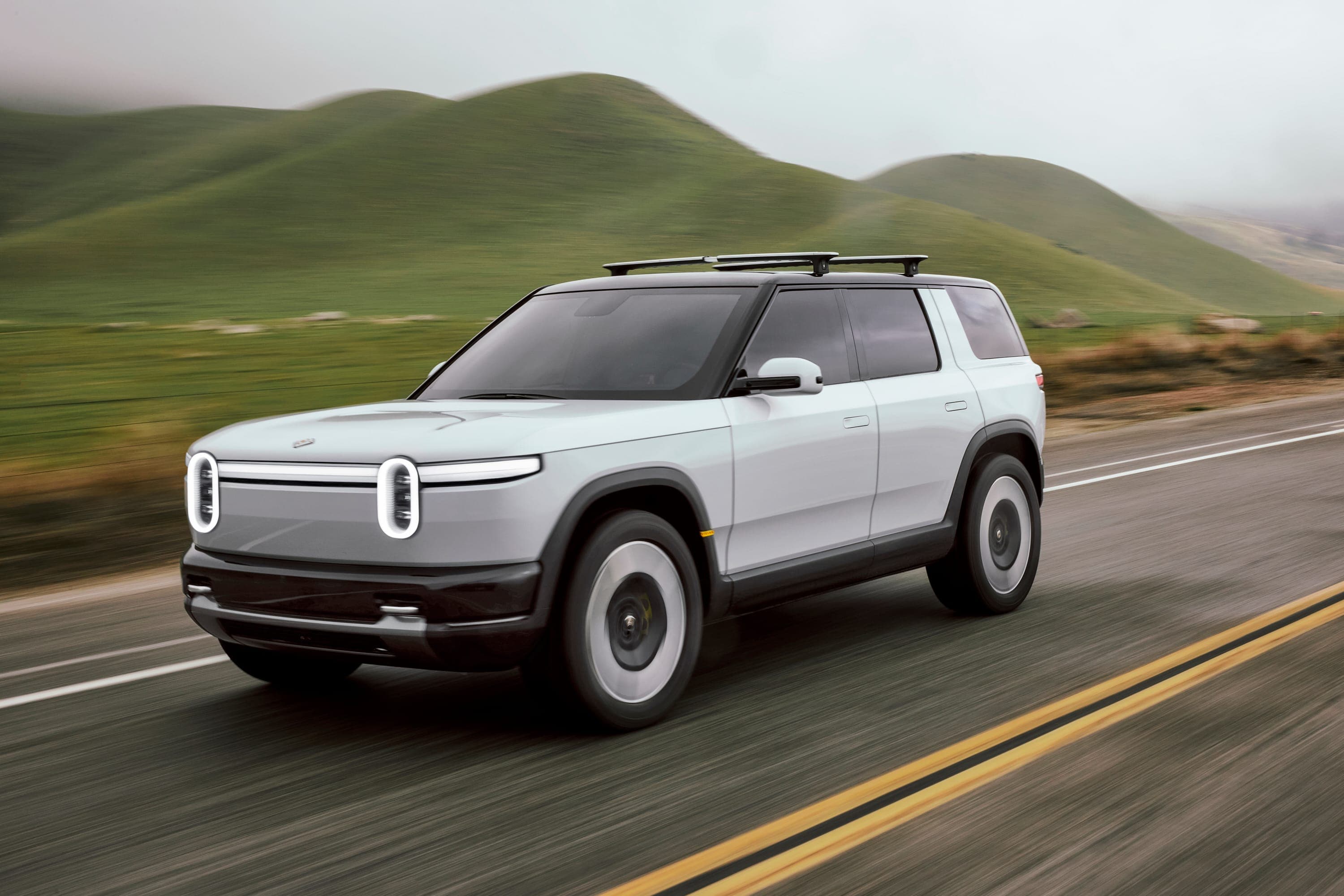
Rivian spent two years marketing the R2 as a $45,000 SUV. The number appeared in press releases, at launch events, and in every headline covering the vehicle. It was a deliberate signal: $45,000 is below the current average new EV transaction price, below the Model Y Long Range AWD, and within reach of buyers the R1 line never touched. When the full lineup dropped in March, the base price was $45,000 — but that trim won't arrive until late 2027. Every R2 available today starts at $48,490. The only model in the first production wave is the Performance Launch Edition at $57,990. That gap is the context this review lives in.
With the R2, Rivian is attempting the same transition Tesla achieved with the Model 3 — turning an upscale EV brand into a high-volume mainstream automaker. The R1 built Rivian's reputation among adventure-focused buyers who valued capability above price. The R2 needs to reach a fundamentally different buyer: someone who wants the Rivian brand without the R1's $70,000-plus entry point. Whether the company can deliver that — at the right price, at volume, without repeating the R1's quality problems — is the question this vehicle has to answer.
Rivian R2 Specs
Set pricing aside for a moment. The Performance Launch Edition is a dual-motor AWD crossover with 656 hp and 609 lb-ft of torque. It runs 0–60 mph in 3.6 seconds. The battery is 87.9 kWh usable. EPA-certified range is 335 miles on 21-inch wheels, 314 miles on 20-inch all-terrain tires. Curb weight is just under 5,000 lbs — heavier than a Model Y Long Range, lighter than an R1S. Ground clearance is 9.6 inches, more than double the Model Y's. Towing capacity with the optional tow package is 5,000 lbs. Payload is 1,168 lbs. The semi-active suspension includes a kneel mode.
Prototype reviewers describe the interior as roomier than the exterior suggests — compact footprint outside, genuine passenger and cargo space inside. Rivian's R1 build quality has been inconsistent, but the R2 runs on a new platform built in a new production cell at the Normal, Illinois facility. Early R1 quality data doesn't apply here. How the R2 holds up at volume remains the open question.
Rivian R2 Efficiency
The most underreported spec in R2 coverage is efficiency. EPA city efficiency is 4.62 miles per kWh. Highway is 3.89 miles per kWh. On a per-kWh basis, that matches or beats the Tesla Model Y Long Range AWD — a result Rivian attributes to software-defined motor management and thermal architecture. For a 5,000-lb vehicle with nearly 700 hp, it's a genuine engineering achievement.
The practical math: at 18.2 cents per kWh (US average, May 2026) and 4.2 miles per kWh combined, you're paying roughly 4.3 cents per mile. At $4.50 gasoline and 28 mpg, that's 16 cents per mile. For a 15,000-mile-per-year driver charging at home, annual fuel savings versus a comparable gas crossover run approximately $1,750. Over five years, that's $8,750 — which narrows the real cost gap against less-expensive alternatives more than the sticker price suggests.
Rivian R2 Range and Charging
DC fast-charging peaks at 210–217 kW. The 10–80% charge takes approximately 29 minutes on a compatible charger. The R2 ships with a NACS port — native, not via adapter — giving immediate access to Tesla's Supercharger network: 21,000+ stations across the US and Canada. Rivian's Adventure Network adds 930+ chargers at up to 300 kW. The Adventure Network recently opened to non-Rivian vehicles via tap-to-pay, signaling that Rivian is treating it as a commercial asset rather than a retention tool.
Level 2 AC home charging delivers 38 miles of range per hour. The portable adapter gets 25. Neither figure stands out, but the DC fast-charging access — two major networks, zero adapters — is a genuine ownership advantage over most competitors.
Rivian R2 vs. Tesla Model Y and Competitors
The R2 is launching without the $7,500 federal new EV tax credit. Section 30D was terminated September 30, 2025. That credit would have brought the base R2 Standard to roughly $41,000 in effective cost. Without it, the comparison math is harder.
| Model | Price | EPA Range | Peak DC Charge | 0–60 | Available |
|---|---|---|---|---|---|
| Rivian R2 Performance | $57,990 | 335 mi | 210 kW | 3.6s | Now |
| Rivian R2 Premium | $53,990 | 330 mi | 210 kW | 4.6s | Late 2026 |
| Rivian R2 Standard | $48,490 | 275+ mi* | 210 kW | 5.9s | Early 2027 |
| Tesla Model Y Long Range AWD | ~$50,000 | 320 mi | 250 kW | 4.8s | Now |
| Hyundai Ioniq 5 Long Range AWD | ~$50,450 | 266 mi | 350 kW | 5.1s | Now |
| Kia EV6 Long Range AWD | ~$47,900 | 282 mi | 239 kW | 5.1s | Now |
| Chevy Equinox EV | ~$35,000 | 319 mi | 150 kW | 6.2s | Now |
| Ford Mustang Mach-E Premium | ~$48,000 | 312 mi | 150 kW | 5.8s | Now |
*Rivian-estimated range for R2 Standard; EPA certification pending.
The R2 Performance beats the Model Y on efficiency and off-road capability but costs roughly $8,000 more. The Ioniq 5 offers a faster 350 kW 800-volt charging architecture but shorter range and no meaningful off-road story. The Equinox EV undercuts the R2 by $23,000 — but gives up the Adventure Network, serious ground clearance, and towing capacity. The R2's differentiation is real and specific: buyers who actually use 9.6 inches of clearance and a 5,000-lb tow rating are paying a rational premium. Buyers who don't are funding Rivian's margin.
The LiDAR Problem
Rivian's Autonomy+ package costs $2,500 one-time or $49.99 per month. Marketing language emphasizes hands-free driving and a path toward Level 4 autonomy. What the marketing doesn't say clearly: every R2 shipping today has cameras and radar only. LiDAR hardware won't arrive until late 2026. Early R2 buyers cannot retrofit LiDAR. The Gen III sensor suite requires physical integration into the vehicle structure. Buyers purchasing now are permanently locked into Gen II hardware.
This is a material disclosure issue. If autonomous driving capability factors into your decision, Rivian's own recommendation is to wait for a late-2026 build or later.
Rivian R2 Production and Company Health
Production started in April at the Normal, Illinois facility. An EF-1 tornado hit the R2 production building weeks before launch, damaging the roof and walls. Rivian recovered quickly and stayed on schedule. The facility targets 155,000 R2 units annually at full rate. Rivian reports one R2 rolling off the line every two minutes at current pace.
A second plant in Georgia broke ground in September 2025. It won't contribute R2 capacity until 2028 at the earliest. For now, all R2 supply runs through Normal.
Rivian's financial position is the real execution risk. The company has described R2 success as existential — that characterization is accurate. R1S and R1T production is being scaled back to prioritize the ramp. The R2's higher volume target and tighter margins leave less room to absorb the quality problems that defined the R1 launch. Every quarter of delays or recalls carries outsized consequences for a company in this position.
Living with the R2: Charging, Software, and Service
The R2's native NACS port is one of its strongest real-world advantages. From day one, every R2 owner has access to Tesla's Supercharger network — 21,000+ stations with a reliability track record no other network in North America matches. Rivian's Adventure Network runs alongside it at 930+ chargers and up to 300 kW. Two networks, zero adapters. For buyers anxious about charging infrastructure, the R2 starts from a stronger position than any non-Tesla on the market.
Service is the open question. Rivian has expanded to 85+ US service centers, and its mobile service program handles many repairs without a facility visit — a model that works well for software updates, minor component swaps, and routine maintenance. The weakness has been parts availability: R1 owners have documented multi-week waits for body panels and suspension components. With the R2 targeting ten times the R1's annual volume, parts supply chains need to scale accordingly. Early 2026 delivery data will be the first real test.
Software is a genuine Rivian strength. The R2 ships with full OTA update support, and Rivian's update history is clean — features added, nothing removed. The 15.6-inch center display runs a unified interface with no legacy UI layers. Phone-as-key, route-based charge planning, preconditioning, and Alexa integration are all standard. The experience at launch is polished. Whether it holds as Rivian scales from a small fleet to hundreds of thousands of vehicles is a question the next 18 months will answer.
Bottom Line
The R2 Performance is a well-engineered vehicle. The efficiency numbers beat the Model Y per-kWh. The off-road capability — 9.6 inches of clearance, 5,000-lb tow rating, semi-active suspension — is unmatched at this price point. Native NACS and the Adventure Network give owners the best fast-charging access of any non-Tesla on the market. The structural problems are equally real: no federal incentives, a pricing rollout that damaged credibility, a LiDAR situation that deserves clearer disclosure, and execution risk from a company still proving it can manufacture at scale.
The R2 is the most important vehicle Rivian has ever built. Not the adventure-focused truck that made the brand — the mass-market crossover that determines whether the brand survives the decade. If Rivian delivers on pricing, range, and production targets, the R2 doesn't just secure the company's future. It becomes one of the defining EVs of the 2020s. At $57,990, that story is just beginning. At $45,000 in 2027, if it arrives as promised, it becomes undeniable. Everything Rivian has built to this point is a down payment on that moment.
3 Replies
View in forum →Went to see the R2 at a Rivian showroom last weekend. It felt smaller in person than I expected — in a good way, honestly. More like something I could actually manage in a parking garage. The $57,990 real price is where I got off the bus. I was hoping the R2 was going to be the regular-person Rivian, and at that number it isn't, not for me.
From a fleet standpoint the R2 is interesting but not a near-term procurement target.
What works: payload and tow numbers are adequate for light commercial duty, and Rivian's fleet portal and telematics integration have improved considerably over the past 18 months. The OTA architecture is genuinely useful operationally — we've pushed firmware to 14 R1T units simultaneously without a single vehicle out of rotation, which is not something any legacy OEM can currently match.
What doesn't work yet: $57,990 sits in an awkward zone for fleet TCO modeling. Our threshold for replacing a full-size pickup runs around $52,000 fully loaded, and the R2 doesn't have the payload spec to displace a full-size anyway. Its real competition is compact pickups and mid-size SUVs where the baseline ICE option is $38–42k. At current pricing the R2 doesn't pencil there.
The number I'm actually watching is the fleet pricing, which Rivian has signaled at meaningful volume discounts. If fleet net pricing lands under $51k with a service agreement, the math shifts. Until then it stays on the watch list.
"$45,000 EV" was never going to survive contact with an actual configurator, and anyone surprised at $57,990 wasn't paying attention to how every other "affordable" EV launch has gone. Price the real-world trim, not the press-release trim.
Specs are genuinely good — the efficiency number beating a Model Y is a real result, not a rounding trick. Give Rivian that one.
Still waiting on the day a "starting at" number on an EV launch slide means what it says.